Don’t Demonize People: Do This Instead
How to (Jurassic) park your emotions toward difficult people


I had a LOT of fun narrating this post. Click the Article Voiceover to hear my spin on it. Enjoy!
—J.
KEY TAKEAWAYS:
- Why viewing people as antagonists prevents demonization
- Four benign mindsets that impede conflict resolution
- How a crafty antagonist wants to be viewed and why
- Where I can help you build these skills
Jurassic Park is one of my favorite movies. After the trauma wore off, I loved it.
I was 13 when I went to see it at the theater. I remember standing in the lobby that night after the film was over, waiting to get picked up, shaken by what I’d just experienced. Try telling my brain that I hadn’t just survived being a velociraptor’s entree (or maybe appetizer - I was a skinny kid).
One of the most unnerving parts of that movie was that no one really succeeded in killing the dinosaurs. I would’ve thought that would be the very first thing you think of when making a theme park that defies God’s will: how do I un-alive these things if I gotta make a run for it? Amazing how the peace-loving scientists survived, but the game warden got munched.

But that’s kind of the beauty of the original Jurassic Park, right? All our protagonists needed to do was get off the island with as many of their limbs intact as possible, whether the wildlife wanted to help or not. (I’m sure, if asked, they would’ve insisted that everyone stay as dinner for dinner.)
Attack matters less than escape. Get out alive.
The next time you’re in a heated discussion or verbal confrontation, I’d like you to remember Jurassic Park. Let it be your reminder that the other person you’re dealing with is a genetically engineered, unnatural creature built by greed and avarice that has no reason to exist probably acting out of automatic, innate characteristics that have very little to do with you personally. Yes, they present a problem — they may even pose a danger — but demonizing them won’t help. Nor will assuming goodwill: sometimes that assumption won’t hold up. If what’s in front of you is a velociraptor, don’t lead with empathy. You have a wiser option.
View them as an antagonist. Nothing more than an opposing force. That’s it.
How and why the “antagonist” framing works
Thinking of someone as an antagonist gives us a healthier way to engage in conflict. To antagonize simply means to oppose. That opposition can be frustrating, for sure, but it isn’t necessarily personal. Often, it’s not really about you at all.
For many antagonists, everything is about “me”.
You need to listen to ME, agree with ME, submit to ME, satisfy ME, aggrandize ME, accommodate ME.
For the pragmatist, it’s about “we”.
If WE are going to get out of this argument, then WE need a lower temperature and a common purpose. WE aren’t getting anywhere right now. Let’s see what I can do so that WE can stop talking past each other.
Or perhaps: WE aren’t getting anywhere, so I’m walking away. Maybe WE can try again some other time… or not.
Great stories don’t always view the antagonist as evil: merely oppositional. That doesn’t always make the antagonist “good”, of course. The dinosaurs in Jurassic Park were instinctual, not evil, but they were absolutely “bad” for our protagonists. That nuance dilutes the concentrated emotions that make conflicts so hard to resolve.
Keeping a healthy (aesthetic) distance
Since I brought up storytelling, here’s a theatre concept that can help you keep cool in a conflict. Aesthetic distance is your emotional detachment from a work of art. A piece that sucks you in emotionally has closed the aesthetic distance. If I can maintain aesthetic distance from my antagonist, then I can view the encounter for what it really is: a performance. You remain a performer, and I choose a higher function.
I’m the director. My job is to make sure this story ends well. The standing ovation you crave is none of my business.
It also spares you from feeling compelled to solve the antagonist’s problem as part of the conflict’s resolution. Jurassic Park’s antagonists ate Samuel L. Jackson simply because he showed up. They would’ve eaten Jeff Goldblum too if he hadn’t said “Must go faster!” The movie ended after the main protagonists escaped, but they didn’t kill the dinosaurs. The “problem” remained, they got around it and saved what mattered most: their lives.
When it comes to conflict, sometimes attack matters less than escape. Get out alive.

One more parallel, and then I promise to stop torturing this metaphor: in the original movie, we’re told about the “lysine contingency” as a backstop if the dinosaurs leave the island. Apparently, they must be supplied with the essential amino acid lysine, or they’ll die. Set aside for a moment that this is nonsensical: no vertebrate animal produces lysine, including humans. We get lysine from our food, including plants, so the carnivores could override the contingency by eating the herbivores. Nerd Rant Over. Setting that aside, escaping is actually the best way to stop the threat because it deprives the animals of their prey (the protagonists) and their nutrition (lysine supplements).
Some conflicts end by starving the antagonist.
Maybe the nutrient they need is attention. Maybe it’s validation. Perhaps misery just needs more company. Some people thrive on brawling with others, impeding progress on purpose so they can keep tussling endlessly. A lot of people just act on autopilot, so they might not actually have a reason: much like the dinosaurs who, as Dr. Ellie Sattler (Laura Dern) says, “have no idea what century they’re in, and they will defend themselves. Violently, if necessary.”
Sound like anyone you know?
IMPORTANT: What an antagonist is not
Here’s where your conflict navigation skills begin to become bulletproof: when you understand the difference between an antagonist and a villain.
A villain must be defeated. An antagonist can simply be navigated.
Demonizing our adversaries has always been lucrative, popular and cathartic. And to be fair, some people actually might mean you real harm. But when you villainize someone, you raise the stakes. Resolution won’t cut it. Now you need victory.
If you’re arguing with a villain, then that makes you a hero. And the whole point of having heroes is to “vanquish” villains. Victory, or… else.
But if they’re an antagonist, then you could just escape them. Survive with your integrity intact, and we’re good.
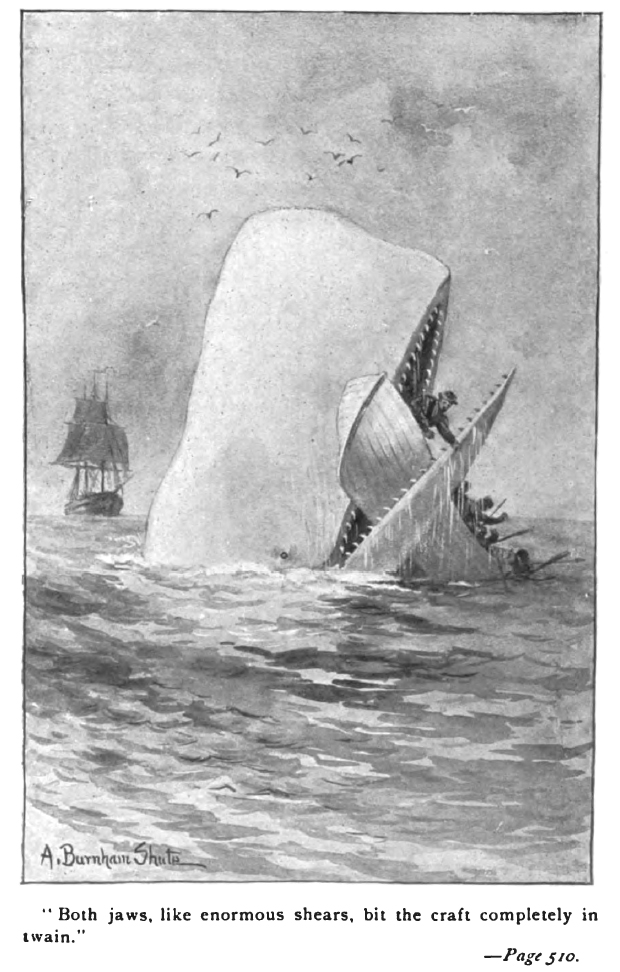
Demonizing an antagonist has its own foreboding icon: Moby Dick.
Ahab survived the white whale’s crippling attack, but his vengeance made the animal into his own personal villain. Now he’s not just the protagonist in a harrowing encounter: he’s the hero on a quest for retribution. It got him killed, and the whale got away (probably).
The epilogue of Herman Melville’s tragedy confirms how foolish demonization is. As our narrator Ishmael awaits rescue, none of the sea’s predators bother him. “The unharming sharks,” Ishmael recalls, “they glided by as if with padlocks on their mouths; the savage sea-hawks sailed with sheathed beaks.”
I can hear the pushback: Isn’t this all semantic? Whether you call them an “antagonist” or a “villain”, that’s about how you see them. But how they see you, and how they treat you, are the real issue. It doesn’t really make a difference to them what term you use.
Correct. It’s a semantic tool to cope with conflict. And that’s on purpose.
These definitions are broad, of course, and they can shift based on the situation. After all, to them, you’re the antagonist. Still, this “semantic tool” gives you the intellectual freedom to define the situation as you see fit. That helps you control your words, your listening, questions, tactics, endurance, and your judgment of when to walk away.
Navigating conflict requires a command over your own mind, not the minds of others. Control your thoughts, and you can control your actions.
Here’s what a crafty antagonist would do
If I wanted you crippled with frustration, I’d do my best to become your villain.
That way, you’d take everything I say and do personally, which would make all your choices emotional. I can manipulate emotions. I’d know it worked by the shift in your attitude and tactics. It burns your emotional fuel, gives me a reason to dig my heels in and, best of all, prevents a practical solution: not unless it’s all about ME, ME, ME.
Being your antagonist is bad for me. That keeps you pragmatic and dispassionate. My behavior shrinks smaller, and your goals loom larger. You keep your head when I’m losing mine, and you’re equipped to deal with me despite your feelings. My best weapon is provocation: without that I have much less to aim for. I might even try to provoke you or insult you — maybe even dehumanize you — just to control the narrative.
That’s why some villains relish their villainy: because it drives heroes nuts.
What you can do: release these 5 mindsets
These mindsets have their virtues, but rarely have I ever seen them ease or end a conflict. Beware of:
- Sentimentality. It can be easy to wish the world was kinder or simpler than it is, and to put yourself out on a limb as a show of faith in the other person. Sometimes that may pan out, but you don’t need it. Releasing sentiment focuses you on your skills, not your feelings, and it makes the conflict simpler to resolve.
- Superiority. Heroes are inherently superior to villains (at least, the heroes think so). Acting out that framing centers your status as a factor in declaring victory. Sorry, but this isn’t the path for people who only want to “win” at all costs.
- Balance. Nor is this path for people who lack patience. If you need for every interaction to be even-steven, 50-50, precisely monitored give and take, where everyone has exactly the same rules to follow and expectations to uphold, you’re really going to struggle. It’s okay not to get the last word or dunk on your adversary. Give up balance to gain progress.
- Nostalgia. Wishing for a bygone era when people were more cordial and polite isn’t going to help. It can easily become an excuse to admit defeat. Don’t forget how many people, especially minority groups, suffered in collective silence to soothe the majority. That’s not harmony; that’s noise suppression.
- Fixing. Maybe you can help meet your antagonist’s need without sacrificing yourself. If you can’t, just navigate it and move on. And don’t get caught up in trying to understand exactly why they are the way they are. Do you need to know that before a resolution can be found?
To navigate conflict, command your own mind, not the minds of others.
Don’t waste time trying to corral, control or kill every raptor in your conflict-driven life. Just escape the island. You’ll show your antagonist that she’s not such a clever girl after all.

Let’s build these skills together.
This piece comes from the first session of a six-part live course I’ll be offering next month. “One Million Moderators” is for anyone who wants to build the practical skills needed to protect their most treasured relationships when divisive conflicts arise. Class begins October 15th — I hope to see you there. Click the image to sign up, or go to MillionMods.com.